Terminus - a weekly comic strip
May 14, 2008

We don’t do news, but…
May 13, 2008
It’s one thing for Newsarama’s boards to host racist invective, but quite another for one of it’s journalists to spout the kind of nonsense quoted in this link. Jon, over at Funnybook Babylon, suggests that Kean should be sacked, a position I have some sympathy with, but what about the editors, what the bloody hell were they doing? Ah yes, covering the whole thing up, apparently.
Okay, I can understand their desire to get Kean’s comments removed sharpish, but wasn’t some kind of apology from the editorial staff necessary? Wasn’t attempting to excise the entire thing without publicly flagging their actions very bad practice indeed?
Rogue’s Review #1: Harley Quinn
May 12, 2008
By God I’ve written some long winded posts. Everyone else has only managed to throw up one or two bigguns, but this here mindless poodle has at least five to his name and it’s time to give myself a break, in the name of my love-life, my free time and my sanity. So here it is, the first of a what will be an occassional, but altogether less masochistic, series of posts where I try to get to grips with what makes some of our fave baddies tick and why they have proven to be so popular. And maybe along the way unearth a few ideas that will serve as pointers, guiding today’s creative powerhouses towards a deeper understanding of their subject matter and, resultingly, a brighter, altogether more interesting future for the characters themselves.
Because everyone at DC gives a flying fuck what I think.
I’ve got this annoying writer’s nervous tick which means I try to make sure that each of my posts somehow segues neatly into the next - that there’s a thematic throughline, even if it’s only tangential. Of course, with this in mind, it makes sense that today’s Rogue of choice, Harley Quinn, should initially spring from a cartoon.

And you can tell because, to this very day, no matter how much time is spent on trying to flesh her out, she still retains cartoonish qualities: she’s wildly expressive, kooky and wide-eyed, she wields Acme style mallets and, moreover, there’s something springy, two-dimensional and slippery about her - all that insane bouncing and backflipping between frames and the way she pours herself across the panels. But there’s something else that adds to the general feeling of intangibility that pervades Harley. Something to do with her obsessive love affair with the Joker and the way that it’s almost her one, essential, characteristic. The way he defines her. She’s incomplete. Ephemeral.
But we’ll save further musings on that score for later….
There are very few comics characters who have successfully made the transition from cartoon to comic book. To be honest, I really can’t think of any off the top of my head - certainly not any with the enduring power of Ms Quinn.
So why is she so popular? Well, I would hazard that there are a variety of contributory factors. To begin with, she has oodles of cheesecake potential - I had to wade through a sea of Harley porn in order to find the images that litter this post. Fandom just loves to slaver over a new, curvy, supervillain, but I think there’s more to it than that. As I mentioned above, her toonish roots come with the suggestion that she’s a caricature of a person. The line is simpler, less complex and perhaps less threatening, and her overall *plasticity* allows for a multitude of (im)possible permutations and violations - we’re back in Wile E Coyote territory, but for mature readers. Nasty. This combined with her potentially slashable relationship with Poison Ivy and the strong S&M dynamic between her and the Joker (more on both of these things later), make for some very dodgy, err… ‘fan art’ indeed.

Okay, Harley Quinn equals sexy-time - so far, so good - but moving on (because, you know: Eyyeuew!), there’s another good, surface, reason for her mass appeal…. Batman’s rogues can be divided into roughly two camps, the flamboyant colourful lunatics with their special gadgets, themed crimes and punned names (The Riddler, The Penguin, The Mad Hatter, Calender Man) and the leering, bestial, monstrous grotesques (Clayface, Bane, Killer Croc, The Joker). Alright, so there’s some overlap, but broadly speaking I’d say Harley fits very nicely into the former category. No matter how backbreaky the Batbooks get, this 1960s type tendency always makes its voice heard - it never quite goes away - and Harley remains its most recent, and consistent, expression. If Batman’s Gotham is, quite literally, an Underworld - with all its mythic conotations of dream, delirium and madness - where one man attempts to engage in battle his primal demons, then it makes sense that the shapes it adopts should occassionally veer towards the garishly improbable and dementedly carnivalesque. Psychosis doesn’t just come in grey - sometimes it sports its very own jokermobile and oversized, branded, chainsaw.
How’s that for a defence of the sillier aspects of the Batverse?
So Harley’s representative of a grand old bat-tradition, but she’s also reflects a more modern comic book trend - reiteration. If Botswana Beast ever gets it finished, you can look forward to a more complete overview of the new Prismatic Age and what it means bedecking your screens at some time in the future, but, for today’s purposes at least, the basic idea doesn’t require a great deal of preamble: comic book fans have started to really dig *anti-matter* knock-offs of their favourite heroes and villains. Just look at everything from early nineties Spiderman, to Supermans Red and Blue, to the replacement Batmen. Something about these clones serves to reinforce the original, underlining their iconic status and extending their reach. They appeal to the post-modernist in all of us, who secretly enjoys seeing the superhero subverted, reappropriated and transformed. Harley performs this function in relation to the Joker. And that really leads me onto the core ideas that inspired me to put together this article.
Harley Quinn’s origin story can be summarised like this: top psychiatrist, Dr. Harleen Quinzel, sets out to unravel the mystery of the Joker, but very quickly becomes dangerously infatuated with him, spiralling into a psychotic love affair that spells doom for all things bat-related. It’s the classic needy oddball meets charismatic murderer and falls head-over-heels narrative all over again. We’ve heard it all before - in the movies, the cliches people spout over a pint in the pub about the magnetism of the psychopathic personality type and in a million fan letters winging their way to the maximum security wing of your local prison. It’s a cliche, and, frankly, pretty boring. So why should we give a shit? Why on Earth does Harley’s tale resonate so powerfully? Because, inspite of some crappy writer’s best attempts to make him so, the Joker is no ordinary psycho.
Say what you like about Grant Morrison’s Joker diagnosis, at least his Joker-as-reflection-of-this-year’s-current-shadowy-zeitgiest is as brave, insightful and ambitious a take on the Clown Prince of Crime and his instruction manual as any I’ve seen. It explains away his unpredictability and all his various, disjointed incarnations better than any other model so far. In short, it makes him scary again. Just as, I would argue, the sad fate of Harleen Quinzel does too. You see, I relayed the skeleton of the Harley/Joker pairing above, but I think there’s a different, deeper and infinitely more terrifying story to tell that roils and churns beneath the surface. There’s a new myth here that the readers feel in their hearts and bones. What really happened there in that padded cell that night, as the lightning flashed outside and the madmen wailed and Harleen Quinzel gave way to Harley Quinn?
A lot of the bat-writers seem to forget that the Joker is a supervillain. Sure, thay pay lip service to the idea - they give him grand crimes to commit, they dress him up in his costume (that old purple suit) and he hangs out with other spandex-clad bad guys - however, they often forget, or fail to convincingly articulate, his real power: his insanity. the strength of his ability to irrationalise the world around him is of a comparable magnitude to Superman’s abiltity to bench-press mountains. Any story that breathes new life into his super-karayzeeness is going good guns as far as I’m concerned. Harley’s is one such story. So here’s the way I’d tell it.

After months and months of meditating upon the occult mysteries of the leering mandala of the Joker’s face, Dr. Quinzel reached a kind of transcendent state, where she achieved a perfect union with the unearthly madness he represents. This unholy, inverted, enlightenment - this triumph of the qlippothic over the divine - effectively overthrew her old, human, personality, replacing it with a cancerous, soul obliterating fragment of the Joker’s. In short - fancy language aside - after peeling back his mask and penetrating his heart, the object of Harleen’s affections retaliated by crawling into her and murdering everything she was.
This isn’t the stuff of Montell Williams.
This is the stuff of horror stories.
So, in true prismatic style, everything that’s great about Harley reinforces everything that’s great about the Joker. At an essential level, the tragedy of Harley Quinn is her inability to return to total selfhood. From a certain point of view she functions as a free-wheeling homuculus of the Joker. So what else does she have to say about him? To begin with, there’s the notion that the Clown at Midnight’s mind isn’t simply diseased, but rather it is the disease itself - that it’s not, in reality, a ‘mind’ at all - and that prolonged exposure to it results in death and madness. Harley embodies this. The Joker’s psyche is the evil, DC universe duplicate of the Frankverse discussed below. It has viral qualities. Arkham Asylum doesn’t just act as prison and rehabilitation centre, in the Joker’s case it acts as quarantine too. He’s a psychic bio-hazard. But if that isn’t enough freaky bad shit to be going along with, there’s also some other really hair-raising stuff to explore. And for that we have to take a slightly closer look at the sort of being Dr. Quinzel has become. Oh, and a quick detour to Tibet.
I first came across the tulpa in one of the many books on Tibetan buddhism that litter my Mum’s house, years before Doctor Doom made an appearance as one in Fantastic Four 1234. Basically, the idea goes like this: if one combines a colossal effort of will with the right magicky hoohaa then one can produce a living, breathing mental projection, with opposable thumbs, consciousness and a personal mission statement.
And what a fantastic lens with which to view Harley! I mean, it’s tempting enough to view her as a clear cut case of possession, what with all that Rag Dolly Anna-style twirling and flip-flopping about (and with her history as a toon and those jingly bells, she looks like a toy, afterall). That would be enough wouldn’t it? It certainly explains away why a boring, untrained and all too human psychiatrist should suddenly, overnight, have the agility, speed, flexibility and high-kicking potential that you’d need to take on Batman if it’s just the Joker virus pulling the strings. Yeah, I like that take - Harley Quinn as living doll/toy - but the tulpa one’s just as fascinating: Harley as solid state thoughtform.
I said there was something ’slippery’ about Harley earlier, when perhaps I should have used the word fluid. She’s like a strip of playing-card coloured mercury, unspooling across the fight scene. And mercury is the sacred metal of Hermes, god of communication, language and thought. In many ways she has more physicality than her pale-faced progenitor - the Joker’s never been that tasty in a fight - and she could be described as affording him the ability to act on (and communicate with) the world in a way that he couldn’t before. She’s his dreams made flesh. This perspective makes sense of their strange but undying love affair. He could never kill her - she’s part of him. She’s an expression of his being that from time to time he may tire of and set the thumb racks on - the Joker’s relationship with himself is anything but coherent and consistent - but will always hold some fascination. She, in turn, desires nothing but to return to him, to clamber back inside the clamouring, relentless hell we might loosely describe as his soul. And there’s a certain poetry to the idea that this blurry, red and black protrusion of same should take the form of a woman, implying not only their intrinsic, satanic union, Lakshmi and Vishnu-style, but also the captain and his ship, the driver and his car…. Without him, she’s a Mary Celeste of a person, floating empty and unruddered, drifting out to sea.
But with him, she kicks ass! In fact, as part of a team, Harley’s always hot to trot.
It’s rare, apart from in her recent, *yawn*, rehabilitation storyline, that you happen across the subject of this post alone. If she’s not breaking into Arkham to rescue the Joker, she’s cosying up in bed with her sometime flatmate, Pamela Isley, and this also serves to illustrate her obsessive desire to complete herself. One might argue that the Ivy/Harley relationship is far healthier than the one she enjoys with the Joker, offering, as it does, the possibility of a life beyond being the cackling one’s uber-henchman. Still, though, ultimately Harley comes off as a symbiotic beast, and I think this frustrates traditional readings of Harley as bisexual. I would proffer the idea that her sexuality might be more accurately described as queer, in that it makes no distinction between male and female and will flow in whatever direction her whims, and her desire to connect, take at any given time. She isn’t fifty/fifty either way, but a shape-shifter whose lusts are contigent on her needs. Needs which may very wildly according to who’s around and who can act as an outlet for her zany psychosis.
I think its fair to say that, when unpacked, there’s something frighteningly misogynistic about Harley Quinn. Whatever way you look at it, she loses a large degree of her iconic power when she’s not a vessel for her ghoulish father/lover. Her entire raison d’etre centres around him. But since when has a bit of misogyny daunted comicdom? We may not like the idea that she’s been mind-raped by the devil, and we’re not supposed to. This stuff should be unpleasant. The Joker is pure bloody evil and what do you think he’d do with the soul of a bendy, pliable, female super-fan? Okay, sometimes he’d just kill her outright or get her up like an elephant, but, depending on how dreadful he was feeling that day, he might try another tack… It’s a good thing all this horribleness is subtext, but we’re all adults here (I hope) and this is the over eighteen version of events. As I mentioned a post ago, it’s an essential component of the cartoon that the characters exist in a state of almost divine grace, where, despite being put through the physical and narrative wringer, they’ll always come up smiling next week, unscathed. And it’s the same with comics’ characters. The successful ones are a brand too, and to retain brand integrity they naturally refute any real change. You can kill them, reform them or dress them up in different costumes, but they’ll always come bouncing back, revised very slightly for a new readership, but in all the ways that matter largely unchanged. It’ll be the same for Harley Quinn, whatever the outcome of this bold new Amazonian course she’s headed on. And for those of you that doubt her intrinsic link to the Joker and think she can exist for any significant amount of time outwith it? Well, just wait and see, guys and gals - Harley will be back in his ever-lovin’(?) arms in no time, just as she is in the ‘toons. It’s her fundamental, perfected state - her status quo:
a sad, wise-cracking puppet zipping in bullet-time over and under and through the laser beam alarm systems of Gotham’s high-security vaults, actualising the nefarious schemes of her terrible master.


What

the

fucking

FUCK !?!?!?!
And now check out these freaks.

I still remember how, as I came up on my first tab of acid, I fretted about the possibility of being pursued by the Mars Bar Man. I had it on fairly good authority that that was the sort of thing I had to expect. That and maybe fairies. But the Mars bar man sounded scarier so I obsessed about him. Animated Mars bars with faces, arms, legs and malicious intent were definitely a hugely bad and strange thing and I’m pleased to say that over the next twelve hours I encountered nothing of the kind. Well, okay, that’s not strictly true.
Because I did come to the attention of a very bizzare pack of Refreshers.
The worst part of the trip involved buying sweets. My friend and fellow psychonaut insisted we pop into a newsagents and buy something sugary, but as soon as the door closed behind me and the little bell TINGED! to signify our arrival I knew I’d made a bad mistake. To begin with the floor was on fire. But more importantly the rows and rows of brightly coloured candy wrappers in front of the till seemed to unspool out of the third dimension, fractal-branching in all directions - through me, the shop-keeper, my chum, the walls, the floor, the ceiling……….. and MY BLOODY SOUL.
I couldn’t take much more of that shit, so I got the hell out of the shop. Only, try as I might to eject it from my awareness, the technicolour yawn of confectionery proved to be unshakable. Especially the brightest, funnest, fizziest confectionary of all: the Refreshers. If I opened my eyes, they were there. If I closed my eyes, they were there. Wherever I went for the rest of the day they would eventually show up, that tangled, twisted, octopoidal mass of rainbowed paper and foil. Forget the Mars bar guy - I’d just met the daddy of all predatory candymen. Actually, please forgive the hyperbole, at this point I have to cop to the fact that after prolonged exposure to this outlandish beast I eventually managed to befriend it. It wasn’t all bad - it looked very pretty and I did love the sweets themselves - but it did come on pretty strong. The thing is, until that moment I had no idea a packet of Refreshers could be so mindwarpingly frightening and beautiful - they were just another tasty treat vying for my attention in the chocolate section. I didn’t know they possessed intelligence. I didn’t know they were alive…..
Damien Hirst articulated the idea brilliantly in his famous piece, The Physical Impossibilty of Death in the Mind of the Living. Not only is the ravening shark of our destruction something we are in deep denial about, but we also find it impossible to approach Hirst’s subject without somehow imbuing it with a sort of awareness. Sure, this could be a trick of its apparent animation, but I would go further and suggest that this is a mental trick we play with nearly everything. What the drokk is God but the summation of the universe with a beard, a couple of thunderbolts and a scowl on his face? This brand of anthropomorphism is alive and well all over the world, and it’s so ubiquitous it’s become invisible. We don’t think about it.
But it really is very weird.
Take America - most Americans, or at least the Americans that do surveys, are Christians. They believe that the universe is essentially a benevolent place and they feel, fundamentally, that it can be their pal. As Grant Morrison [Oh no! Not him again!] put it: ‘trees are your friends, animals are your friends -even atoms are your friends!’. Everything’s on your side. And where does this attitude find its ultimate expression (apart from in church)? What medium does it employ most effectively to reach into the hearts and minds of the young and old alike? The cartoon and its not-so-distant cousin, the comic book.

It’s not called The Magic Kingdom for nothing, folks.
Yes, Disney has a lot to answer for. I’ve got nothing against injecting the world with meaning and invoking the internal radiance of the everyday, etc, etc, blah - see my last post for proof - but like so many others I instinctively rail against the way Mickey Mouse has hijacked our inner shamen and spun a pack of lies to us about a bug-eyed, grinning, simpering universe, where everything is simply a projection of our most inane, idiotic and boring-arse ideas about our children, ourselves and our place in the world.
The Disney brand, and that of other prime movers and shakers like Warner Brothers‘ Loony Tunes, has proven to be not only incredibly enduring, but has also helped to form the template for the modern cartoon and a raft of kid’s comics. They have the money, the visibility and the influence to cement their vision in our collective consciousness the world over, but little do they know that in doing so - in making the cartoon so popular - they have sown the seeds of their negation. I’m not suggesting for one minute that Disney is ready to keel over, just that the territory it explores, the shapes it takes and the forms it chooses to adopt are anarchic by their very nature, and can serve as a jumping off point for a whole world of weirdness. Goofy is so pervasive that he’s become dull as dishwater, but he doesn’t have to be.
He can be the Refreshers’ wrapper. It’s all a matter of perspective.
Jim Woodring’s creation, Frank, probably owes more to cartoons than it does to comic books and the, albeit small, but devastating sorties it makes into the realm of the four fingered glove, although unlikely to bring the magic kingdom to heel, always bring a smile to this poodle’s face. Woodring’s work exposes the grande-guignolery and strangeness that lies beneath Toon-land’s smiling, dot-eyed mask. Obviously their are other creators working in this tradition - so many cartoons these days revel in the grotesquery and madness of their form and subject matter - but Frank takes it to a whole new level. And, despite the popularity of the more bizzare, exciting cartoons like Sponge Bob Square Pants, it’s still difficult for us to separate out all things Mickey from all things animated. Those of us, at least in the west, who enjoy the form always seem to be mentally positioning the toons we watch either for or against the mouse. Basically, anything that successfully detournes the dream factory’s worth a look, even if the political/ideological impact of the piece is negligible, experienced by a relatively tiny number of readers compared to the audiences for Bees, and ultimately amounts to little more than schadenfreude. It’s just nice to see Minnie put through Woodring’s blazing, luminous, conceptual juicer.
And for all those anti-conflict, synthesis loving guys out there - it’s also nice to see what Minnie-squash tastes like, because it’s not all horrid E numbers, there’s some real yumminess washing around in there too.

‘So what’s it fucking well about, you pouffed, yipping ponce?!?’, I hear you ask. Well, if you haven’t picked Frank up yet - and shame on you if you haven’t (who’s the pouffed ponce now, eh? EH? Fuck you!) - each strip depicts a day in the life of the titular hero; the comings and goings and doings of a generic anthropomorph. No, that wasn’t me reaching for the thesaurus again - that’s exactly how Woodring describes the species Frank belongs to. And that’s it, right there.
Sortie number 1.
Woodring’s classification underlines a series of ideas buried in the cartoon animal: that not only are they are projections of ourselves, but also, by this point in the early 21st century, it’s implied there’s a whole world of these creatures out there. For what exactly is Frank? Is he a cat, a mouse, a squirrel, a gerbil - the bastard child of Bugs, Mickey, Garfield and Chip and Dale? He’s generic, he’s the Everyman - the cartoon equivalent of the-man-on-the-street. Just one of millions. Frank embodies the suggestion that toonland extends beyond the boundaries of the credit-roll, and that cartoon characters, on mass, lead autonomous lives outside of the texts that detail the adventures of the more famous ones. And that these lives can be as banal as ours. Like the teeming masses Frank holds down various jobs, courts the affections of the pretty lady down the street, walks his dog, dreams of striking it rich…. But the word banal used in this context - a world of talking cats and singing trees - has radically different connotations from our daily trips to the supermarket or work. Especially on the outer fringes, where things are less sanitized - where things aren’t intended for mass consumption.
Because Woodring’s making explicit ideas that are implicit within the cartoon - because he is essentially expanding upon stuff that is already making ripples on the surface - he manages to generate a whole new lens through which we can approach the original subject matter, affording us the opportunity to unpack the ur-texts in a way we couldn’t before. He tells us that the world wasn’t all that funny or cute to begin with, or at least it was never solely these things, and that all the horror and wide-eyed wonder his stories instill exist right around the corner from Cinderella’s castle. He doesn’t just critique the genre, he effectively reinvigorates it too.
If Mickey and Bugs and co. are entry-level anthropomorphs, then Frank, Man-hog and the rest represent more or less total immersion within this shuddering, primary-coloured landscape. Populist cartoons serve as a safe and secure vantage point for exploring the fantastical, whereas the mirror Frank holds up to our internal environment reflects a more contorted, but altogether more truthful image of our imagination and its potentialities. The generic anthropomorph is essentially empty - a conduit for our ideas about the way a portal to toonland should look - and, like his more child-friendly cousins, acts as a bridge from here to there…. But let’s get on with it and have a closer look at what there looks like.
Sortie number 2

!
Out where the buses don’t run, and where deranged cartoon physics are unconstrained by notions of morality, humanity and brand integrity, Frank and his pal Pupshaw roam, going about the day to day business of complete trippy strangeness. It’s just where they live. The place is home. But as for us, we get no Frank 101 and there’s no expository text. We’re expected to be at home too, dropped, right there, in the thick of things. Perhaps Woodring counts on us already knowing this world intimately prior to burying our snouts in it.
And, as I’ve said before, we do. We’ve all seen a million and one cartoons.
Frank, however, doesn’t just stop at cheeky-chappy kettles and dancing monkey-friends. Oh no. Frank goes all the way. Just check out the contents of the rather shoddily thrown together, but utterly bizarre diorama above. Everything - literally everything - in the Frankverse appears as if it might be possessed of intelligence. The Mars bar/Refreshers man army have invaded by stealth and we await their first move. The scenery lurks. It’s not just cartoon mice that gawp, stare, go boss eyed, smile and generally communicate like the (in this case very creepy) bloke opposite you on the tube - it’s the buildings, the fauna, the flora, the weird kite people and individual elements of indoor furnishing.
‘Isn’t it beautiful! The firmament is heaving with loving awareness!’
Only, ummm, not so heavy on the *loving* part.
Just look at that red building up there snarl! And those other two looking on aghast above it! The frowning, peering, waterspout. The gawping foliage…. I’m not sure I’d describe any of this stuff as friendly, and I’m certainly not sure its apparent intelligence is in any way human. We might find something of who we are scattered across the million masks of God that form Frank’s home - this place is anthropoland, afterall - but that doesn’t mean we’ll happen upon ourselves offered back up to us in an easily recognizable form. In Frank the singing trees may possess the operating system of a shark, and the houses all the winning charm of the octopus. We’re out of the comfort zone of simple anthropomophism and entering the realm of primal animism. If the god of Disneyworld is our happy-go-lucky pal, then the god of the Frank books is probably Great Cthulhu. Is the universe happy? Is it sad? Or does it just want to eat? This place’s emotional repertoire consists of more than just a series of ploys to make the child in us go snuggly. It employs the whole spectrum of emotion and It can accommodate every strata of awareness, from the human, to the animal, to the lizard-brain and beyond.

I mean, what is that thing?!?
Woodring levels the playing-field, so that it’s not just our reflection staring back at us out of the page, but a whole world of myriad intelligences - a world that is as sharkopomorphic as it is anthropomorphic as it is morphopomorphic - and it aggressively interrogates the whole process of applying meaning and coherence to an indifferent universe. And these points yield two conclusions: that Frank has the ability to horrify precisely because we are all well trained to seek out the smiling face beaming at us from behind the cartoon universe and instead we’re confronted with a jelly-fish’s (what an unpleasant surprise!), and, also, those weird blobs, dots and squiggles we call a face? Well perhaps we’re really staring at random markings on some kind of carapace?
What if there’s no-one there at all?
We’re a long fucking way from the singing trees. You always knew where you were with those guys. At least they had noses and grins, a sense of fun and self-hood. I think Frank up there could be in severe face-hugging danger if he credits the cute little ‘head’ emerging out of that weird monster-plant thing with a genuine personality.
Frank reminds us we’re not the centre of the universe. It’s scary and, on reflection, humbling.
But what’s Frank’s face made of anyway?
What is this stuff?
Sortie number 3

The cartoon depiction of the body is symbolic as opposed to literal, and the symbolic body is subject to very different laws from the physical. See Wile E Coyote squashed flat as a pancake by a passing boulder, or Tom unspooling out of a blind while Jerry runs for it, if you need further proof. It can be mashed, stretched, twanged and dissecated. It undergoes imposible violations, inaccessible to us, but for Daffy Duck these permutations and contortions are just part of the nine-to-five. He is essentially expressive in nature and, if his creators so will it, his *body* will become a space for the child to explore crushedness or pan-facedness. It cannot be irrevocably changed, but it will be perpetually transformed. And like a child, our cartoons are still testing the limits of the tangible world. ‘What does it feel like to be drawn like a bow?’, ‘How does it feel to blown up?’, it asks, but Frank, goes even further, to posit a body so reactive and polymorphously perverse that it responds not just to physical impacts, but to more abstract impressions too.*
How does that there twisty-turny thing’s operation feel?

Here Frank experiences a-deep-dark-well-with-eyesness,

here he critiques modern art,

and here’s Manhog-looking-at-Frank-but-with-a-brain-injuryness.

The symbol is simply reacting with symbol, but in a more rarefied form. The avalanches and the fizzing bombs of the frankscape are psychological, emotional and ontological, and they map across the flesh of its characters in mind-wrenching ways. The skin, like a toy’s, like imagination, is plastic.
And if Woodring wants it to bleed, or rot, it bleeds and rots as well.


Frank explores every aspect of its character’s potential for mental/physical distortion, including rupturing, blood and breakage. It makes nauseating forays into the secret world of actual pain and disfigurement. The tension between the assumedly indestructible form of the generic anthropomorph and depictions of it suffering or succumbing to age - this recomplexifying of the line, this three-dimensionalisation of the two-dimensional - effectively resensitizes us to violence and makes for a new kind of body horror.
Woodring examines (psycho) physicality in so many ways. He takes his cue from Disney, Hanna Barbera and the rest, but he dares to take the human form to the outer-limits, unencumbered by late 20th/early 21st century conceptions of childhood and what is and is not suitable viewing matter for an 8 year old. So the building blocks of Frank’s world, symbol and imagination, can construct visions of horror, humour and outright aestheticism for our pleasure - everything, from the abject to the awesome, is permitted.
I mean, it has to be remembered that whole UNIVERSES fit in there….

Perhaps we shouldn’t have low expectations regarding our children’s favourite form of entertainment.
So we’ve had a little look at the properties of Frank and his backyard, and now it’s time to have a look at the properties of the stories that tell him.
Sortie number four.
Most American cartoons obey the law of cyclical return. The characters have to show up next week for the next episode, fully intact, so that they can undergo the slings and arrows of outrageous physics anew. Frank is no exception. The undying body encourages a non-linear rather than a progressive story-telling mode. Woodring’s tales are discreet bubbles instead of snap-shots of exciting moments that fit together to inform a larger life-narrative. Unlike a Bugs’ cartoon, Frank’s little skirmishes don’t always work out that well for him. Sure, we’re on Frank’s side, but that doesn’t mean he necessarily outwits his eternal antagonist, Man-hog, week in, week out. Sometimes he finds himself at the wrong end of the narrative-stick, broken or killed by his enemies, and other times it’s business as usual - curtains for the pig-people. We never know. Woodring enjoys the endlessly rotating dynamic of the kid’s cartoon as much as he enjoys subverting it and our expectations. Uncertainty of outcome is suggested by a world whose creator’s finger is ever hovering over the re-set button, but in the Tweety Pie toons the story is constrained by the fact that we’re on his side, that we know he can’t be beaten. There’s an inbuilt morality that privileges the underdog. Normal cartoons can be very cruel, but only at the baddy’s expense.
Not so in Frank.

I think it’s fair to say that most of the Mickey, Goofy, Daffy, Tom and Jerry, Roadrunner and Foghorn Leghorn Saturday afternoon shorts are a lot like long, protracted jokes, where ceaseless conflict eventually resolves itself into a punchline, and that most blockbuster toons obey a similarly predictable structure - the Hollywood narrative. The content doesn’t matter as much as the shape of the thing. A huge amount of the pleasure audiences derive from this stuff is the product of how reassuring it all is. We feel our way around the story’s twists and turns - the exercise is anything but intellectual - but we do not grope around in the dark, because the territory is so well travelled. We feel our way around the frankverse, too, only here we have no idea what to expect. It has the same preference for the aesthetic over the intellectual, the emotional over the cerebral, the imaginal over the physical (there are no words in Frank) and dream logic over Aristotelian as the traditional ‘toon, but, again, untrammelled and allowed free reign. Resonance, not cause and effect, is the prime-mover in Frank. The story tells itself the way it feels it should. We don’t necessarily understand all its contortions - why does Frank collapse after looking through Grim’s telescope? How does he know to build the Cart Blanche? What is that terrible face under the sea? - but they make organic sense. This isn’t work to be empirically read, but to be watered. We watch it grow.
Like a triffid.

Aaand Woodring retreats, drawing his breath….
There’s so much more I could talk about, but I think I’ve probably said enough. I’m sure you get the picture by now. The thrust of this piece is that the Refreshers’ wrapper was already freaky enough to begin with, if only I had eyes to see. The psychedelic experience allows us to experience the outright alienness of the everyday and Frank is, quite literally, although I hate this expression because its so bleedin’ trite, *Disney on acid*. The broader toonverse Frank details is as anarchic as the cartoon promises it could be. It reminds us, through its adoption of familiar forms and tropes, just how outrageous the acme novelty company’s products really are, hopefully foreshadowing and laying the foundations for a more disruptive art form - Mickey Mouse in the World of Tomorrow, a million light-years from the Epcot Centre and its conservative, 1950’s-style visions of our individual pasts and our collective future.
Frank reclaims the spectacle, acting as a cartoon derive, affording us the ability to reimagine and renegotiate the squidgy territory of our childhoods. Children don’t experience the world as an endless reiteration of lovecuddly impressions - the view from their window is as frightening, incandescent and disturbing as our own, if not more so, and the lies we tell to children about winking moons and benevolent suns are lies we tell ourselves. I accept that it’s perfectly natural for us to create the universe in our own image, but *we* are a gazillion times more outlandish and many tentacled than we let on. Woodring knows this, and he steals back the hallucination in order to remind us. No matter how hard we try to package, limit and sanitize the substance of things, both imaginal and otherwise, the universe instinctively tends towards the marvellous, demented, unfathomable and uncaring. The world, the word and the flesh don’t always make sense, there is no intrinsic battle between Good and Evil and the clean and proper body will erupt in deforming cancers without rhyme or reason.
It seems a shame that this excellent medium for befriending The Other is popularly understood as low art - a child’s diversion - because we can learn a great deal from children. If most American cartoons highlight that stage in a child’s development when (s)he is engaged in the process of constructing a bounded self and, necessarily, a nice, equally clearly bounded morality to go with it, then Frank journeys further back still, to an even more mercurial time, where mind and body and outside world have yet to succumb to the weights and measures of space, time, ego and super-ego. Where all the (now) boring, daily toings and froings of flesh and awareness are magical, revolting and impossible. Where a bug can be as pure a role model as good old Dad.
I haven’t taken hallucinogenics much because of a propensity to have bad trips, but just because something’s alarming, it doesn’t mean it has no value. One of my scariest trips involved the discovery that my spine was like a stamen extending towards the sky, and my mind - my brain - was a flower whose petals were endlessly unfolding, conveying the light of awareness to my central nervous system. It sounds like hippy shit to be sure, but, I can assure you, the realization that you are in fact just a short hop-skip-and-a-jump from a plant, at four in the morning, loaded on panic magnifying drugs, is a soul shredding one. Jim’s perfectly at home with this point of view and this revisioning of the body forms the unspoken thematic perspective his comics adopt. So if Disneyland has the quality of a cartoon mouse that takes the reader by the hand and gently guides us around his wibbly but altogether cosy home, then the Frankverse is a hostile invading organism, colonising our awareness and viral replicating, like those seas of eyes and cute cartoon faces that infest its panels. (THE HORROR! THE HORROR!). But don’t worry, that’s just the democratization of reality at work. It’s very hard to accommodate this new understanding, but, like a trip, if we ride it out, it can emerge as pretty bleedin’ beautiful. I mean, we don’t see Frank spending all day freaking out about it. There’s nothing wrong with the idea that we’re not the hub the universe swings around - that the other lies out there - it’s just new information. There’s nothing wrong with the idea that the body doesn’t do as it’s told. We’re just unused to it. In the end, we cannot deny the weasel under the cocktail cabinet forever, and the brave amongst us will voyage out into this dreadful new sphere, perhaps bringing back a trophy or two for us to gawp at along the way.
Jim Woodring is one such pioneer and he forces the Disney crowd to be complicit in his disturbing ontological fun and games.
Long may he continue, the Mars bar man tapping us on the shoulder.

* Okay, cartoon characters do sometimes respond to non-physical stimuli, like sexual attraction, but Frank takes this idea to a far more, err, *mental* place.
Iron Brew
May 8, 2008
What could be more relevant to the pissed up youth of today’s binge Britain than an absurdly over produced reprint of ‘Demon In A Bottle, the story of one billionaire superhero’s descent into alcoholism, collectably timed to coincide with the release of Iron Man (reviewed below, with spoilers aplenty), the first of this summer’s movies to claim the title of blockbuster.
Personally, I’d given up on the golden avenger before the story line began. There was only so much George Tuska art work I could take. Visually, Iron Man was at his best drawn by Gene Colan, whose work on the series looked even better reproduced in black and white in Britain. Colan gave Iron Man’s classic armour (designed by Jack Kirby) a sensual power that managed to turn the hero’s encounter with Whiplash into an S & M fantasy.
Plot wise, faltering repulsor rays and Aunt May stylee heart attacks quickly bored, while Iron Man’s alter ego, Tony Stark, was so at ease with his wealth, women and the world as to inspire nothing but resentment. It’s no wonder that for many fans Stark’s brief descent into alcoholism remains the standout event in his life.
‘Demon in a Bottle’ is realised in what now must be regarded as old-skool comic book aesthetics. I should have realised that the exploration of a superhero’s psyche late seventies style meant in-your-face four colour art, rendered even more garish here by a glossy paper stock, and a gratuitous team up with the Sub-Mariner.
Most of the artwork is by John Romita Jr and Bob Layton. It is perfectly functional but Junior is still in his early, silk shirted days of mine’s-a-bitter struggle while Layton is laying the groundwork for his fan-pleasing X-O Manowar (I am afraid I never got past the character’s name). A fill-in by Carmine Infantino retells the origin of Iron Man, but gives everyone huge jaws, big teeth and bigger hair. Even the Vietnamese look like they’ve just finished a photo shoot on the shores of lake Como.
David Michelinie’s plotting stands the test of time a little better. The political intrigue involving SHIELD (which he inherited) and Roxxon suggests that while the pace of storytelling has changed over time, the basic tropes that characterise the genre and even individual characters has changed more slowly. It really is only a short step from here to Tony Stark-Director of SHIELD.
In a brief introduction, Michelinie reveals he learnt his storytelling skills during a degree in Communication Studies. The secret is to keep it real. The trouble is this results in a bathetic sub-plot involving a lonely old man, Hiram Dobbs, who has had the misfortune to make his home on an island that is the only known source of Vibranium outside of Wakanda. I challenge you not to shed a tear as the hermit’s world explodes in “a scathing eruption of light and fury, a holocaust made even more awesome by its total, uncompromising silence!”
Just as you thought things couldn’t get worse Micheline spews forth (his words, honest) the most lamentable (my words) villains in the Marvel Universe including Leap-Frog (he leaps!) Stiletto (he throws knives!) and the Beetle (he, er, beetles!). It’s enough to drive a man to drink. And sure enough, Stark is soon hitting the hooch and his staff are deserting in droves.
A highlight of this graphic novel is the reprinting of Jarvis’ resignation letter (follow the link and scroll down for the text). In a hilarious act of industrial sabotage some Marvel employee pasted in an actual letter of resignation which saw print with a few amendments and is seen as a damming indictment of editor-in-chief Jim (the secret of the New Universe’s success will be its realistic representation of plumbing) Shooter.
The actual crisis-of-multiple-tipples is quite short lived (one issue) and seems to have had no lasting impact on the character. Imagine: this armour of mine keeps my heart beating, but not even the power of arch technology can save my pancreas!
Booze flows just as freely in the new Iron Man movie aided by a script that sees Robert Downey Jr. as Tony Stark knocking back the script like a bottle of pleasant plonk. Downey’s reputation for a more-than-zero tolerance of substance misuse compliments a performance that make the most of Stark’s play-boy life style (best sight gag: a private jet cabin that turns into a night club complete with pole dancing air crew.).
Downey is the main reason to watch this movie. His transformation from a would-be Puff Daddy Warbucks to the eponymous Iron Man takes up the entire movie without becoming bogged down in the portentous navel contemplation of Batman Begins or the Spider Man movies. Sometimes Superheroes don’t stand for higher things, often they just stand for flying around zapping baddies with repulsor rays.
The other characters exist only as plot functions. Pepper Pots (Gwyneth Paltrow) has a character that seems contingent on the mechanics of the scenes she’s in - by turns “peppery” as she evicts Stark’s one night stand from his Malibu Mansion; a slightly nerdy industrial spy as she down loads data from Stane’s personal files; and a screaming Fay Wray in the hands of a metal King Kong. A romantic interlude on a balcony is followed by a postmodern moment where Stark explains to her the generic conventions of being the girlfriend of a superhero. The scene is funny and as slickly written as much of the movie, but it doesn’t go on to offer a credible alternative.
However, no amount of postmodern gesturing can rescue the faltering morality that lies at the heart of the movie. Stark’s own change of heart (from arms dealer to avenging angel) comes when he learns his good weapons aren’t only killing the bad guys (assorted shifty mercenary types and entire villages of swarthy looking men, women and children) but are killing good American Soldiers. You see weapons of war are good when good soldiers use them. When bad people use good weapons against good people, entirely innocent mines, missiles and machine guns become corrupted. And that’s bad.
The moral ducking and diving continues as the film tries the convince us that the villains are only Taliban look-a-likies and are actually a rootless, multi-cultural rag tag gang called the Ten Rings who are actually led by Stark’s own mentor, co-board member and best buddy. Frankly, even the script writers can’t believe this and the motives of the group or of Obadiah Stane (Jeff Bridges) are entirely unclear. After all, Stark Industries don’t need to create wars to sell weapons, the American presidency is quite capable of opening up such markets on its own.
Then there’s the Iron Man costume itself built, if I heard the throw away dialogue correctly, to explore other planets but which handily has enough weaponry to take out tanks, mercenaries and a big non-identical twin that turns up for the film’s climactic battle. The violence is delivered as Tex Avery slapstick. But even the audience of 10 year olds with fake IDs that I watched the movie with looked uneasy at the comically choreographed scenes of burning bodies and exploding tanks. It is, of course, an axiom of action movies that dealing death is a laugh riot as long as you get the timing right.
In the event, the most politically on-the-nose observation is Stane’s remark to Stark that just because you have an idea doesn’t mean you own it. How Stan Lee must have chuckled at that line. True the credits acknowledge Jack Kirby, Don Heck, Larry Leiber and Stan Lee, but there’s a fair bit of Warren Ellis and Adi Granov here. One knock-off scene from Extremis has a family thrown about in a car but the movie achieves a double whammy by making the car an Audi.
In fact, the movie is an extended advertisement for Audi and Dell who break the Hollywood convention that AppleMacs are everyone’s PC of choice. Stark’s request for a good American Cheese Burger seems like a plug for Burger King, but when the burger is delivered - on the steps of the Walt Disney Concert Hall - the logo is fairly indistinct so I guess the company didn’t cough up enough money for a proper product placement. Speaking of cheese, Stan Lee makes another Hitchcockian appearance. The credits say he appears as himself, but Stark greets him as “Heff”. If they ever make a Mighty Thor movie, Lee should be a shoe-in for the role of Ego The Living Planet.
There are fans crying out for an exploration of the ‘dark material’ (sic) of ‘Demon in a Bottle’ (hic). I support this, but only if the movie includes the Sub-Mariner, The Porcupine and Hiram Dobbs. Actually, I hope Marvel resists the temptation because part what makes the movie work is partly its joi de vivre, of the kind that made the first Fantastic Four film just-about-bearable, together with a clarity of storytelling that still eludes the Batman franchise after a decade and more of trying to get it right. It would also be good to see a sequel upping the political content in a kind of super heroic take on The West Wing and increasing the moral sophistication.
Unfortunately, a post-credit scenes with Nick Fury (Samuel L. Jackson, ho ho) and loose talk about “The Avengers Initiative” portends the kind of multi-character complications that up-ended Spiderman 3 and Batman Begins. There’s a thin line between becoming entangled in continuity complications and being immersed in an entertaining ‘universe’. The trouble is you can only tell when the line is crossed by the painful experience of watching it being crossed, so I’ll be awaiting the sequel with less that baited breath. Till then True Believer-Make Mine a Martini!

Note: The Mindless Ones do not condone excessive drinking of alcohol. If you find your drinking is having an adverse effect on you family, friends and work life contact Alcoholics Annonymous and repeat after us “The Mandarin is not an appropriate higher power.”
Terminus - a weekly comic strip
May 7, 2008

This is how the story ends… The Order #10
May 5, 2008
I came to praise the Order and to bury them and now it seems neither action was mitigated.

They should have just died, really. Or at least most of them - that’s how it feels. The Order was a re-use of a trademark, like Marvel Boy, like X-Force under Allred and Milligan, that wasn’t really affiliated in any sense other than the vaguest to its priors: Marvel Boy was a Kree like Captain Marvel, X-Force were mutants - The Order… was actually intially a rebrand of the original Defenders. Because this incarnation was supposed to be called The Champions (of Los Angeles, as the Marvel site helpfully adds). That was the one thematic link: that they were not situated in New York City, but rather Marvel’s second locale: the West Coast, Bay Area, primarily LA and San Francisco. And the company failed to maintain, and lost, the trademark to the latter. It’s hard to feel sorry for a corporation (really, when is it not?) - particularly given their bullying and dubious joint ownership of the term “superhero”, enforced fairly regularly - but it was hardly to give this, up to its penultimacy, resolutely acceptable and likeable product the least troubled of launches.
Nevertheless, lemonade was made: the little black incision on the perpendicular right of the circular red logoes was chipped off and lo! There was an ‘O’ upon the chestplates of these champions (of Los Angeles, and sometimes San Francisco.) And they defended the state of California, and it was good: progressively improving, I should say, from issue to issue and evoking much mythography from a road less travelled. Natural disasters - firestorms, tidal waves, earthquakes - which seem that much more relevant to the geography, the complexes of the star system in La-La Land, class warfare…
It was an odd and quite affecting artifact, filling in these aspects in the mighty Marvel method quite modernly with the single issue focus on each of the cast intercut, VH1-style, and visualized through the straitened and reserved linework of Barry Kitson, making for an interesting tension. It could conceivably, without the latter, have been a deal more obnoxious and I almost wish it had been, in retrospect. This was a comic apparently from an alternative history where a publication house had set up on the left coast. The characters were all just innately decent: they’d signed their “morals clauses” - fallible, but plain nice, not bleak. Acted pre-Watchmen, affirming, looked like they were drawn in that time-period. There’s a point about Fraction’s idealism, or specific idealism for Bronze Age Marvel Comics to be made, probably more extensively, so the subplot from #3-4 (when you think Calamity James Wa might do something appalling to a rube but then it turns out, thankfully, he absolutely never would,) alongside Punisher War Journal #4’s paean to the more caperish and clearcut villainy of the Eighties seem to indicate.
Never a doyenne of the messageboards and blogs in the way The Immortal Iron Fist was, at least until David Aja’s absentia, nor even something I could rouse myself to break out the hot endorsements for, but something where - when discussed - you’d say, the conversation would go: “It’s good. It’s consistently improving. I like it. Um.” Dick Hyacinth probably offered the most glowing appraisal of the series, but only then with a backdrop of lamentation as to why it had not succeeded. Co-creator Matt Fraction was consequently insistent, after the news of the cancellation, that financial realities with Kitson, who’s now I believe to be a regular on the Amazing Spider-Man reboot, and his inability to continue on the rates offered on the book meant he felt it necessary and correct to end the series.
Which is a shame, and a little sad, because new properties - even trademark maintainees, now - almost never gain even the remotest bit of suction in the world of big superheroes™. Runaways is about the sole exception from about the last decade, and the final issue of this hitherto vibrant and filled-with-potential title hits that point with dull and thudding accuracy. The arrow hits a red-headed bullseye and reports: The Order? Less important, less viable, than Virginia “Pepper” Potts. Which is… I liked her as portrayed in the comic, I don’t want to be dismissive of fictional secretaries or anything. She’s a lot more significant and useful in the sort-of Oracle role here than she was typing missives and sighing wistfully over the boss; I was initially confused by her pantheon assignation of Hera (rather than Athena) in that quickly, probably wisely, abandoned hierarchical model. But she’s in a movie, you know, which is a particularly abject lesson for LA supers - in a movie = much superior. Is pre-existent trademark, mother figure to Iron Man’s Zeus-daddy = double-win. It’s just i) ropey and ii) unsatisfactory to have the ‘natural order’ reasserted so blatantly and perfunctorily - The Order, in the end, were second and third fiddle, didn’t matter terribly much, in their own book. They served as a prequel to The Invincible Iron Man. Their unifying baddie, the man behind it all, was the son of that movie star’s antagonist, out to destroy them purely because he hates Tony Stark, the Iron Man.
But he fails to kill them all and it’s already like, it’ll be like, those ‘What they did next’ programmes after Big Brother: I hope I never see you again, demi-celebs. Under the deathless pen of the 21st Century’s answer to Peter David, Dan Slott, as the issue appears to indicate may be the case? I hope I never see you again, ninth-raters. Cameoing in the title you led into? I hope I never see you again, really. Fraction faked and ex machina‘d, almost literally, out on the prior issue’s cliffhanger which had grippingly appeared to indicate some, possibly dissonant but interesting and fitting, pathos and distress were in store, straight out the gate here and the book was already in trouble. One of the team goes then. Or, more correctly, in the timeframe between #9 and #10 (wherein, also, apparently insurmountable odds are duly surmounted) and is confirmed at the beginning of this ish. Then, blah blah, chaos ensues, the book’s themes are ill-unified and the team given sub-par power replacements, denuded of their specialities, and one has to make an Ultimate Sacrifice of another. The latter, somewhat troublingly, is the only gay protagonist in a fictional arena hardly overburdened with them. This is not the first time this has happened. It’s all so cursory and dismissive, formerly attractive characters scarcely apparent, a wrap for what was a very enjoyable newish comic. I should emphasise, of course I was buying #10 of a comic because I had enjoyed each of the previous issues, some of them a great deal, but the last panel - a wearisome group shot, crammed into the bottom fifth of a page, just served to emphasise how much goodwill this finale had chewed up. As a fate for these nouveau trademarks, death would have been a more fitting, apt and useful testament to what is proving to be an extraordinarily static milieu at present; rather that than this liminal consignation.
The Yellow Eye sheds a tear
May 5, 2008
Over comics bought and read on Saturday the 3rd of May
The Immortal Iron Fist #14
Written by Matt Fraction and Ed Brubaker
Drawn by Tonci Zonjic, Clay Mann, and Kano
Published by Marvel Comics
The theme this week is sadness. Which brings me straight onto Iron Fist, which ain’t looking anything like as immortal as I’d hoped. But, never mind, I’ve got to the point where I’m not so unhappy about that. If you ask me - and you should - this book’s never really got beyond teases of skillience.
What’s skillience? Super martial arts. Work it out.
Brufracaja’s desire to expand and explore the Fist mythos was - apart from being sexually exciting - the stuff of worthwhile intentions. The Seven Capital Cities of Heaven tickled my Chi, and their champions stirred the kind of geeky emotions usually reserved for Mooreian or Morrisonian creations. And, okay, I must admit to giggling with glee when Orson Randall let rip with his ninja-flame bullets. I even got off on that legacy Fist business. But. Where was Danny Rand amongst all that? Uttering the odd supercool yet strangely dull as bruised balls line about being a captain of industry, billionaire, superhero, that’s where. Making virtually zero plot driving decisions, that’s where. Being unforgivably boring, that’s where. Now, lest anybody think I’m committing the cardinal sin of favoring storytelling rules over storytelling results, I should stress that I don’t think there’s anything wrong with putting Danny on the back seat, per se, however it was a very odd creative choice to make early on in the book’s run, and it’s a dangerous game to play if you want people to give a shit further down the line. Mainly, though, it points towards the real problem: a scattershot focus.
One hundred and onety five squintillion subplots do not a good story make*. I asked where Danny Rand got to, what about the martial arts contest? Did that even end? I didn’t notice. I was too busy trying to work out why I should care about John Amman, Jeryn Hogwarts, Power Man and co, Iron Fist’s dad, Hydra, Ju Te, secret revolutionaries, Davos, Orson’s mates, cosmic convergence, other. tedious. stuff. By the time this issue rolled around my hopes for Streetfighter 2 meets Marvel heroes was down the shitter, instead I got Danny hitting a train (nothing like as amusing as it sounds), and ensuing anti-pathos (is he dead? No he isn’t. I’m so not surprised I could weep. On this comic) And… do you know, I can’t even remember the rest of it, and I can’t be bothered to open the book and remind myself. That’s how engaging the team’s final issue turned out to be. And that’s why I’m sad, because I was prepared to forgive this series a lot.
I love it when creators aim high. Mainstream comics are bloated with mediocrity, but, like Daniel LaRusso, Iron Fist was trying that much harder, and when it found its feet it kicked arse better than most. Even when it fucked up it threatened kung-fu coolness a few pages down the spine. But, God, it was fucking up far too often, particularly towards the end. It never delivered the crane kick to the face, or if it did I was too busy being distracted by all that redundant Hydra business to spot it. Which is a such a shame, because I was rooting hard for the K’un Lun massive. I even forgave Fraction his bloody awful name (which he chose) for a minute there.
*There’s a thing here about the expediency of the legacy fist stuff, and how it might have been a clever editorial ploy designed to ameliorate the problems created by the deterioration of the creative team, but that’s a route to forgiveness I feel disinclined to explore. The end result might have been better than it could have been, but it still wasn’t good, and David Aja never did catch up.
DC Universe 0
Written by Grant Morrison and Geoff Johns
Drawn by loads of people
Published by DC
Picture the scene: A sad young buck enters a comic store. It’s Free Comic Book Day, time to try this cape fetish on for size! Maybe here he’ll find the acceptance he’s always craved. Hey, what’s this? A big promotion for a book called DC Universe 0, a jumping on point for new readers signposting all kinds of exciting stuff starring Batman and Superman and other cool dudes, handcrafted (he’s informed by the guy behind the counter) by the best in the biz. Wowzers! That’s for me! thinks the now hopeful young buck, who whips the book off the rack and dives into…
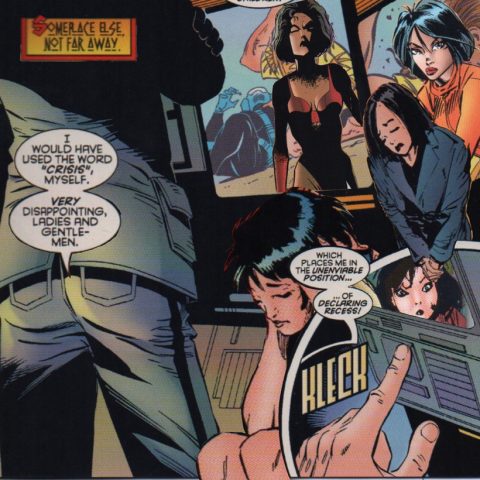
…Impenetrable nonsense, made from fanboy excess and badness. It’s just about then that the pitiful young buck realises that DC hates him, that the guy behind the counter hates him, that all those people clutching their bagged comics hate him. That Superman, Batman and the Justice League all hate him. Poor lost young buck, this is, surely, his Final Crisis (see how I lol). The belt-strap noose beckons.
Yeah, yeah, hyberbole, but, Look, I love Grant Morrison when he’s on his game, and Geoff Johns is a capable writer if a little too conservative for my tastes, but this was just terrible. Admittedly I sort of enjoyed it on the first read through, but that’s only because I’m a complete bitch for the DCU and a little overexcited about GM’s forthcoming cosmic jaunt. When I reread it with more sober, critical eyes, the effect was markedly different and had me asking whether anyone in the DC office has an ounce of sense. Only hardcore, cape wearing geeks (like me) are going to get anything out of this, and we don’t need a bloody teaser, we’re in anyway. As a primer for the DCU or this Summer’s mega crossover, it’s… well, despite a wonderfully concise distillation of all that Crisis stuff, it isn’t, is it? It’s bunch of unconnected scenes thrown together seemingly at random. It doesn’t prime anything, except perhaps a hand grenade made out of crap.
In short, a week of wrongness. Good thing I bought Bone. Bone is good.
Ambush Bug for President!
May 2, 2008

OR: 10 Reasons why Ambush Bug is the Most powerful Superhero in the DCU.
OR: How I learned to stop worrying and love the CRISIS.
OR: I knew I should have turned left at Albuquerque!
With the joyful return of Irwin Schwab later this year, and with the impending End Of The World ™, now seems a good time to reappraise the greatest character ever to appear in comics ever in the world. Ever.
AMBUSH BUG!!!!!!! !!!! !! So let’s begin with a rundown of why he’s the most powerful superhero in the DCU, and how he could make Superman cry like a little girl, and hand Batman his ass on a plate, and could even kick the shit out of Frank ‘The Tank’ Miller…
- Ambush Bug knows he is in a comic. It took Animal Man 27 issues to find this out, and when he did he ended up in Glasgow. The Bug knew from the outset. Crisis-schmisis.
- He has survived death a million times. Superman did it but it took a while, and when he came back he had a mullet. The Bug does it EVERY DAY. Sans mullet.

- He is related to both Bill Bixby and Howdy Doody. This is a fact, as evidenced by his family tree in Ambush Bug no.4. Hal Jordan is not related to anybody good. He’s just a boring space policeman with no imagination.
- He has encountered Darkseid…AND LIVED! Have you? I thought not.

- He stands alone. The Bug needs no team to make him feel like a real superhero. In the Ambush Bug Nothing Special, he is refused entry to the Legion of Superheroes and the Doom Patrol. And he had his head rammed up a giant teddy bear’s bum when he did so. And anyway he was in the best version of the Justice League. You know the one that was in 52? With Bulleteer and Firestorm and…some other people. You know the one that existed for about two pages?
- He has an amazing recipe for Teriyaki burgers. The Flash doesn’t. He probably only knows how to make pasta and pesto. The Bug knows flavour.
- He is not constrained to merely American comics. The Bug is a multi-national Superhero, unencumbered by petty notions of boundaries and style. He was manga before all those little goth kids were.

- Ambush Bug totally has the best sidekick, in Cheeks the Toy Wonder. Seriously, fuck Robin and forget Green Arrow’s one who was all smacked up. And definitely forget Aquaman’s little mer-buddy. I have. Because Cheeks is a combat medic, a zombie toy-cannibal, and brave little sidekick martyr all rolled into one loveable, mute bundle. Plus after he gets blown up (in Ambush Bug 1) The Bug does the decent thing and hits the nearest bar. Good Bug.
- In these turbulent times of moral confusion and mature readers the Bug offers a complex and grown up take on super-heroics for adults. Not baby men. He understands that not all crimes can be solved with a kick to the balls.

- He knows his way around a joke. I mean Wonder Woman definitely has her plus points, especially if you need someone to sort out a minotaur or settle a God’s hash, but she’s not exactly a giggle to be honest. Whereas the Bug is someone you want at a dinner party.

AND LADIES TOO!!